
The 2G/3G sunset is not a network event — it's an estate event
When an operator announces a switch-off it publishes one date. For a utility with tens of thousands of cellular-connected meters that date is almost the least important part of the story — the exposure starts years earlier and ends months later. Read correctly, the sunset isn't a network event at all; it's an estate event measured in coverage, power and lifecycle, not a date on a carrier's press release.
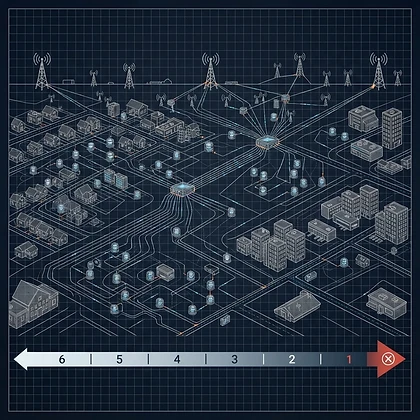
The operator sees one date. The estate sees a multi-year window.
Operators see the shutdown the way any infrastructure owner sees decommissioning: a fixed date, a regulatory filing, a press release. Internally, most of the degradation that matters to a device estate happens well before that date — spectrum gets re-farmed for 4G/5G capacity, roaming partners drop legacy support first, and low-traffic cell sites are thinned ahead of the ones carrying dense urban demand.
For a utility, the published shutdown date is really the last, most visible milestone in a multi-year exposure window that opened when the operator's investment priorities first shifted away from 2G/3G — often three years or more before switch-off. Treating it as a single milestone is how utilities end up running an emergency device-swap programme instead of a planned one.
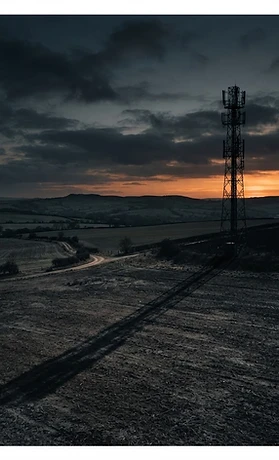


Degradation doesn't hit every meter the same way or on the same day. It follows the operator's commercial logic: capacity gets reallocated to where the return is highest, so dense urban areas — where an operator has the most competing claims on spectrum but also the most customers — tend to keep usable legacy coverage longest.
Rural and edge-of-network sites, where 2G or 3G may already be the only surviving generation on a thinly loaded cell, are usually the first to be decommissioned or simply left uninvested. An estate can look 95% healthy on average while its most remote, hardest-to-reach meters are already going dark.
Illustrative pattern, not a forecast for any specific operator.
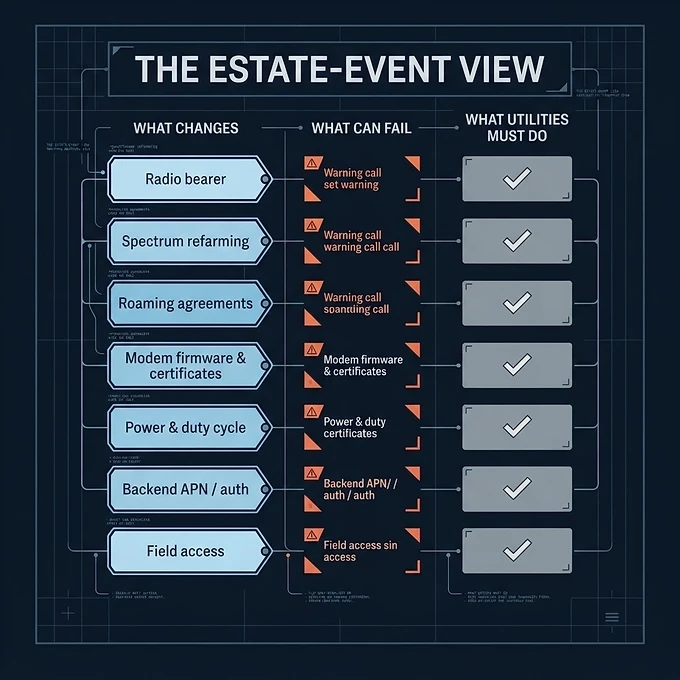
The coverage curve is only the headline risk. Underneath it sit eight estate-level exposures that show up long before the last cell goes silent — none of them announce themselves as a "network sunset".
1 — Coverage erosion by geography
Rural and edge meters lose reliable connectivity first — and they are usually the same meters most expensive to reach with a truck roll, and least able to absorb a fallback to manual reads.
2 — Retry-storm battery drain
As signal weakens, devices attempt more connection retries before giving up. Every failed attach cycle spends power a battery-only meter wasn't designed to lose, pulling replacement dates forward by years.
3 — Hardware-locked modules
Some 2G/3G-only modules have no over-the-air path to a newer band. Where there's no firmware fix, the only remedy is a physical module or meter swap — a hardware programme discovered too late for its lead time.
4 — The '4G capable' misnomer
A modem spec sheet listing LTE does not mean the firmware, APN and certificate chain support the operator's live 4G service. Many do not, and only a lab attach test proves it.
5 — Backend certificate / APN expiry
Authentication servers, APN gateways and platform certificates reach end-of-support on the same timeline as the radio. The modem may be fine — the backend is not.
6 — Fault misclassification
When reads go missing, fault-management rules built around meter-level faults often diagnose a bad device rather than a degrading network — sending a technician to fix a meter that was never broken.
7 — Loss of dual-path resilience
Where cellular has been used as a backup path behind RF mesh or another primary network, that resilience quietly disappears first — leaving the estate more exposed exactly when the primary path is under the most strain.
8 — Physical access
Replacing a meter or RTU means a field visit to an asset you may not own, in a location you cannot always reach. Logistics, not modems, set the critical path.

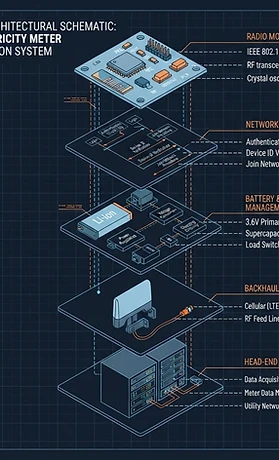
Zoom into a single meter and the exposure follows a specific chain, from the module's chipset out to the operations team reading the data. Each stage carries a distinct, nameable risk as the network degrades — and each one looks, in isolation, like an ordinary field issue.
The window closes years before the headline date, which means the response has to start years before it too. Five near-term actions compress the exposure window before the formal migration programme begins.
Inventory by chipset, not meter model
Group the estate by module chipset and band capability — 2G-only, 3G-only, or multi-mode with an LTE-M/NB-IoT fallback — not just by meter make and model.
Map coverage against carrier plans, not the shutdown date
Overlay published re-farming and cell-thinning schedules where available, and treat rural and edge segments as the near-term priority.
Model battery drawdown under retry conditions
Forecast field life assuming higher retry rates, and re-sequence replacement for the oldest-battery, weakest-coverage segments first.
Budget hardware-locked modules as a swap programme
Where there's no over-the-air path, plan lead time, logistics and workforce as a physical deployment, not a patch cycle.
Separate 'no data' from 'no meter' in triage rules
Update fault-management logic to flag network-pattern data loss distinctly, before it's misread as a device fault at scale.
None of these requires the new bearer to be chosen — they are the work that buys the time to choose it well.
Great Britain's smart metering
A national rollout timed against the 2G/3G sunset. Success depended on inventorying the estate early and validating end-to-end — not just the modem.
15,000-device replacement
A water utility replacing a legacy telemetry estate. The binding constraint was field-access scheduling, not device unit cost.
Japan 3G shutdown
A phased, well-signalled sunset. Operators and utilities coordinated years ahead — the lesson is that early signalling preserves the time needed to migrate.
UK advanced / AMR metering
Half-hourly AMR estates where backend certificates and APNs, not radio, drove the failure timeline.

"The new modem connected once."
"The estate can complete its remaining lifecycle without any dependency on 2G or 3G."
Read as a network event, the sunset looks like someone else's problem with a fixed deadline. Read as an estate event, it's a multi-year programme that rewards utilities who start counting down early — and it opens years earlier, closes months later, and is measured in coverage, power and lifecycle rather than a single day.
The most important metric is the sunset-safe estate percentage — the proportion of devices proven to deliver their intended service without any operational dependency on 2G or 3G.
- 01Ofcom — Future of 2G and 3G mobile networks (consultation & statement)
- 02UK Government — 2G and 3G switch-off: guidance for organisations
- 03GSMA — 2G/3G network sunset tracker (global)
- 04EE / BT — 2G and 3G switch-off customer guidance
- 05Vodafone UK — 3G switch-off announcement
- 06Telefónica UK (O2) — 3G switch-off statement
- 07Three UK — 3G switch-off guidance
- 08DESNZ — Smart Metering Implementation Programme updates
- 09Smart Energy GB — Smart meter rollout reporting
- 10GSMA — Mobile IoT in the 4G era (LTE-M / NB-IoT)
- 113GPP — LTE Cat-M1 and NB-IoT specifications overview
- 12ESMIG — Smart metering device lifecycle guidance
- 13Utility telemetry estate case literature (anonymised)
- 14Operator refarm & coverage planning documentation
- 15CEHG field practice notes — bearer migration assurance


Chris Gales
Chris Gales leads CEHG. He converts complex technical and commercial choices into clear decisions and dependable outcomes for utilities running connected device estates at scale.
He writes these field notes from the practice — on bearer migration, smart metering architecture, procurement and operations — to help estates start counting down early.
Was this briefing useful?
A quick signal helps us write sharper field notes. Your responses are anonymous.
Get the field notes in your inbox
Bearer migration, architecture and procurement commentary from our practice — no marketing fluff.